
Google Ads Data: How to Use It to Target Your Link Building Campaign
Queries that convert and cost a lot in Google Ads are the priority targets of a link building campaign: they point to the pages, anchors and media to choose.
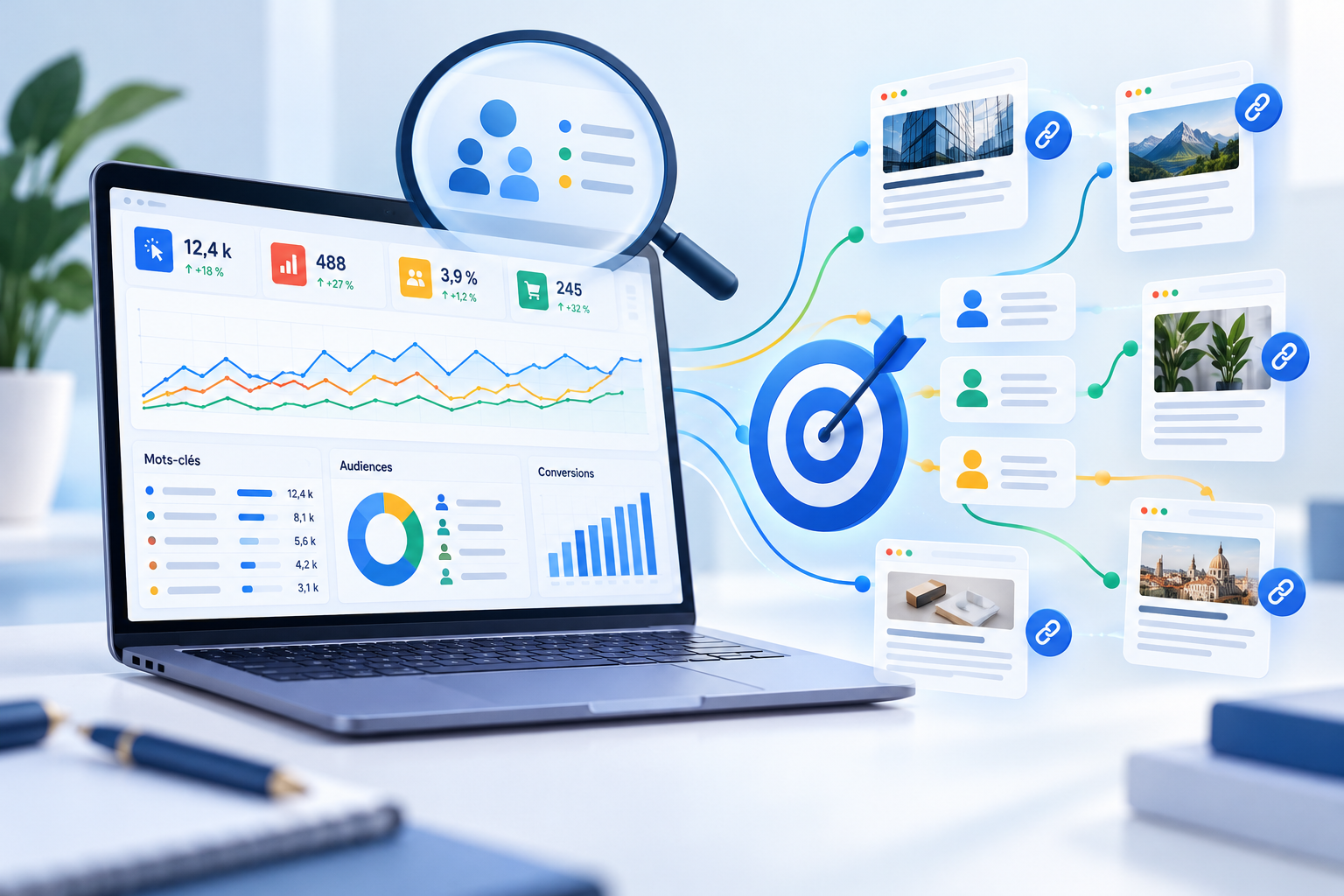
Summary
A company that runs paid search knows the value of every query down to the cent. It knows which ones convert, what a click costs and which pages close the sale. Yet when it is time to launch a link building campaign, that data usually stays inside the Google Ads account. Target pages and anchors get picked from search volumes, without knowing whether those queries bring in revenue.
The two levers do not work the same way. Paid search buys a slot that disappears the moment the budget stops. Link building strengthens pages in Google's organic results, and articles published in media outlets are among the sources that ChatGPT, AI Overviews and Perplexity read. But both work on the same queries.
This article shows which Google Ads reports to export, how to turn them into target pages, anchors and media choices, and what that data does not tell you about visibility in AI-generated answers.
Key takeaways
- Google Ads data shows the commercial value of a query (conversions, cost per click), which SEO keyword tools do not provide.
- Four sources are enough: the search terms report, the paid and organic report, landing pages and Keyword Planner.
- The priority targets of a link building campaign are queries that convert, cost a lot in paid search and where the site is weak organically.
- Paying for an ad does not get a brand cited by AI: on ChatGPT, the advertiser is also cited in the answer in only 3.63% of placements (SE Ranking, August 2026). Mentions and links in media outlets play that role.
Why Google Ads data helps target a link building campaign
SEO tools estimate search volume and difficulty. Google Ads measures something else: what a query actually produced for the business. Every search term comes with a cost, a number of clicks and, if tracking is in place, conversions. It is the most reliable data for deciding which queries deserve long-term effort.
This matters because paid search does not improve organic rankings. Google says so in the Google Ads help center: investing in paid search does not affect organic ranking, as the two activities are kept separate. A brand that pays every month for a strategic query gains no organic position from it. To rank for the long term, the page has to gain authority, and that is the job of links from media outlets in the same field.
At Getfluence, choosing the media for a campaign starts from the same question you would ask a Google Ads account: on which topics does the brand already convert, and which media cover those topics for the right audience? Paid search queries answer the first half. For the second half, the criteria to find the right media for a link building campaign (topic, audience, editorial quality) take over.
Key point: Google Ads shows which queries pay off, but does not improve their organic position. Link building takes over on those queries.
The 4 Google Ads reports to export before launching the campaign
The search terms report
It lists the actual queries that triggered your ads, with their clicks, cost and conversions. It is the basis for all the work: it shows the exact words customers use, not the ones the advertiser chose. One limit to keep in mind: since September 2020, the search terms report only shows queries searched by a significant number of users. Part of the long tail therefore does not appear.
The paid and organic report
This is the most useful report for link building, and the least used. Once Google Ads is linked to Search Console (you need to be an administrator of both accounts), it shows ad clicks and organic clicks side by side for each query. It reveals queries where the site only exists because it pays, and those where it already ranks well organically. Two caveats, according to the Google Ads help page on paid and organic results: it only covers text ads on the Search Network, and organic data is only recorded from the linking date, with no history.
Landing pages
The landing pages report shows which URLs convert best. They are natural candidates to receive links, as long as they are indexable and substantial enough to rank organically.
Keyword Planner
Keyword Planner gives search volumes and an estimate of what it costs to show an ad on a keyword. It is useful for sizing queries on which the brand has not yet run ads. Google notes that low-volume keywords do not show up, and that sensitive categories such as health or finance often return few results.
Key point: linking Google Ads to Search Console before the campaign is the most valuable step: without history, the paid and organic report cannot measure the effect of the links.
Turning paid search data into a link building plan
Once the exports are gathered, each data point maps to a campaign decision. This table sums up the correspondence.
| Google Ads data | What it reveals | Link building decision |
|---|---|---|
| Query that converts, high CPC, few or no organic clicks | A costly dependence on ad budget | Priority target: strengthen the matching organic page with links |
| Query that converts, already ranking well organically | A position to protect | A few consolidation links, then test a lower bid |
| Landing page that converts | The best answer to the intent | Link target, if it is indexable and complete enough |
| Wording of search terms | Customers' exact words | Topics and angles for articles published in media outlets |
| Query that costs without converting | Traffic with no commercial value | Exclude from the campaign's targets |
Choosing target pages
The page that converts in paid search is not always the one that can rank organically. A landing page built for ads is sometimes short or excluded from indexing. In that case, links should point to the SEO page that answers the same intent, and that page can be enriched with the arguments that convert in the ad.
Building anchors
Copying the paid search keyword list into anchors produces an artificial link profile. Queries are used to choose the page and the topic of the article; the anchor has to read naturally in the text. A mix of brand anchors, descriptive anchors and a few anchors close to the query remains the baseline.
Choosing media and topics
The wording of search terms shows which editorial worlds your customers live in. A query like "switch home insurance provider" points to personal finance media and a practical article, not to a general news site.
Key point: paid search data decides the targets and topics; editorial quality and natural anchors decide the value of the links.
What Google Ads does not tell you about visibility in AI answers
The queries that convert in paid search are also asked, as questions, to ChatGPT or AI Mode. And advertising has arrived there: on August 18, 2026, OpenAI announced the launch of ChatGPT Ads in 31 European markets, including France, from August 24. Ads appear below the answer, separate from the generated text, for users on the Free and Go plans.
Paying for that slot does not put the brand in the answer. According to SE Ranking's study on ChatGPT ads (August 2026, 50,006 commercial prompts across 20 niches in the United States), an ad appears on 25.94% of commercial prompts, but the advertiser is also among the cited sources in only 3.63% of placements.
What gets a brand cited happens elsewhere. Ahrefs' study on brand visibility factors in ChatGPT, AI Mode and AI Overviews (75,000 brands, December 2025) finds weak correlations with ad spend (0.273 for ChatGPT, 0.215 for AI Overviews) and strong ones with brand mentions across the web (0.66 to 0.71). Anchors containing the brand name reach 0.628 in AI Mode. The raw number of backlinks, on the other hand, correlates little: it is not the volume of links that counts, it is their context. Ahrefs points out that these are correlations, not causes.
For a campaign, the consequence is concrete: queries that convert in paid search define the prompts to monitor, and articles published in media outlets in the same field, with the brand name in the text and in the anchors, feed the sources these assistants read. That is the principle of Getfluence's AI-First format: articles written to be picked up in AI answers, published in the media those AIs cite on the targeted prompts.
Key point: an AI ad buys a slot below the answer; a citation in the answer is earned through mentions and links in media outlets.
Measuring the effect of links with the same tools
The paid and organic report also works as a dashboard after the campaign. For each targeted query, it tracks three columns: organic clicks, ad clicks and combined clicks. If the links work, organic clicks grow on the targeted queries.
When a query reaches a stable organic position, the next step is to test a lower bid rather than stopping abruptly, and to check that total combined clicks hold. Google itself recommends this report to see how budget or bid changes affect paid, organic and combined traffic. The gain is then measured in paid search budget freed up for the same traffic.
On the AI side, measurement means tracking brand mentions on prompts derived from the queries that convert, before and after the articles are published. Citations vary from one answer to the next: you need regular tracking, not a one-off check.
Key point: measure in combined clicks and paid search budget saved, not just in rankings.
Google Ads data is the best starting point for a link building campaign, because it shows what pays off before it shows what people search for. It points to the queries to strengthen, the pages to push and the wording of the articles; links and mentions in media outlets do the rest, in Google as in AI answers. First concrete action: link Google Ads to Search Console today, so measurement starts before the first link.
Your questions on Google Ads and link building campaigns
Does paid search improve organic rankings?
No. Google states in the Google Ads help center that investing in paid search does not affect organic ranking: the two activities are kept separate. Paid search helps SEO indirectly, through the data it produces: queries that convert, cost per click, pages that close the sale. That data is what helps target content and link building work more precisely.
Do you need a Google Ads account to use Keyword Planner?
Yes. Keyword Planner is built into Google Ads, and Google specifies that you need to set up your account by adding billing information to access keyword ideas. The tool provides search volumes and cost estimates. For sensitive categories such as health or finance, it often shows few or no results.
Which Google Ads keywords should a link building campaign target first?
Queries that combine three signals: they convert in paid search, their cost per click is high, and the site appears little or not at all in organic results. These are the ones where a better organic position most reduces dependence on ad budget. The paid and organic report in Google Ads helps you find them.
Should paid search keywords be reused in link anchors?
Not as they are. A paid search keyword list copied into anchors creates an artificial link profile. Google Ads queries are used to choose the target page and the topic of the article; the anchor itself has to read naturally in the text. Anchors that contain the brand name also matter for AI visibility: Ahrefs' December 2025 study associates them with a 0.628 correlation with brand mentions in AI Mode.
Sources
- "About the search terms report", Google Ads Help, accessed in 2026
- Limitation of the search terms report to queries with sufficient volume, Google Ads notice to advertisers, September 2020 (reported by Blog du Modérateur, 2020)
- "About measuring paid and organic search results", Google Ads Help, accessed in 2026
- "Use Keyword Planner", Google Ads Help, accessed in 2026
- "ChatGPT Ads expands across Europe", OpenAI, August 18, 2026
- "ChatGPT shows ads on 1 in 4 commercial queries. Yet, 1 in 7 appear for the wrong topic", SE Ranking, August 2026
- "Top Brand Visibility Factors in ChatGPT, AI Mode, and AI Overviews (75k Brands Studied)", Ahrefs, December 2025 (updated August 2026)