
Why Readers Engage More With Sponsored Articles
Engagement is an essential factor in brand promotion. If an audience doesn't engage with an advertisement, they're unlikely to remember the brand or look...
Summary
Engagement is an essential factor in brand promotion. If an audience doesn't engage with an advertisement, they're unlikely to remember the brand or look into it in more detail.
Getting that engagement from traditional display formats, like banner ads, is hard. An eye-tracking study by Inskin and Lumen, run over 3,160 experiments and reported in 2018, found that only about 12% of served display ads got any visual attention at all, and just 4% were looked at for a second or more.
In other words, most banners are on the page without ever really being seen.
Fortunately, there are other ways to present a brand, and people actually spend time with them.
Whether your purpose is to launch a product or service or promote brand awareness, sponsored articles deserve a place in your plan.
People Are Open to Ads That Fit the Context
Compared with banner ads, sponsored content earns attention instead of interrupting. And audiences are more open to advertising than is often assumed when it fits what they're doing: in Kantar's Media Reactions 2025 study, 57% of consumers had a positive attitude toward ads in general, and online sponsored events ranked 7th among their preferred ad channels, the highest position ever reached by a native online channel.
Marketers are moving the same way. The same study found that 61% of them expect to increase influencer and creator budgets, another form of brand content delivered in someone else's voice.
What Makes Sponsored Articles More Engaging?
They Provide Value To The Reader
Sponsored articles offer much more value than a single banner ad. Rather than being 100% advertisement, they are meant to inform, explain or entertain the audience.
Whatever the format, a sponsored article reads more like a story and doesn't force advertising on the audience.
Consumers choose to engage with sponsored articles. They click on them because they're interested in what the publisher has to say. That choice alone makes a sponsored article more engaging than a banner ad.
Their Approach Is Subtle
Branded articles are less direct and less ad-like than display ads. That matters, because about 1.1 billion people, or 30% of internet users, were blocking ads at the end of 2025, according to eyeo's 2026 ad-blocking report. Many of them use ad blockers on mobile, where usage has grown fastest.
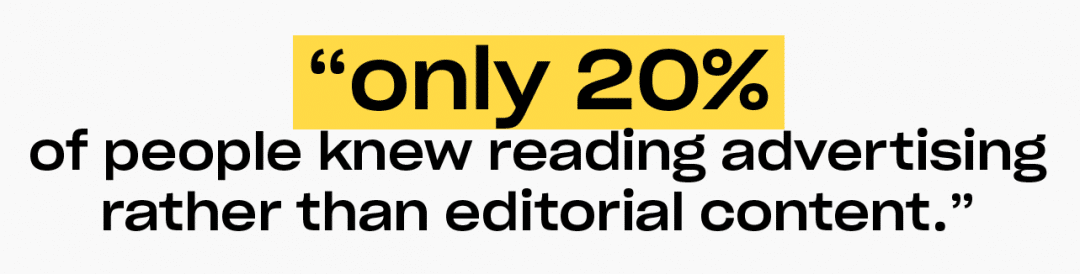
Sponsored content also blends into a publisher's editorial flow. An older academic study published in the Journal of Advertising in 2016 found that only around 20% of participants recognised they were reading advertising rather than editorial content. That is a reason to be clear, not to hide anything: a good sponsored article is labelled as sponsored, and readers stay with it because it's useful.
This lighter approach means audiences are more likely to engage with sponsored content, and to enjoy it, than with traditional ad formats.
They're Written By The Publisher
A key feature of sponsored content is that the publisher produces it, not the brand that pays for it.
Readers are not only more likely to engage with the article, they also see it more favourably.
People are much more likely to care about what a publisher they follow has to say than about what an unknown brand tells them. Trust in media is not a given, but it is holding up: the 2026 Edelman Trust Barometer puts it at 54% on average across 28 countries, up 2 points.
And because readers trust the publishers they choose to read, they're unlikely to drop an article just because it's labelled as sponsored.
The Quality Is There
Because publishers create sponsored articles themselves, the content has to meet their editorial standards.
Many advertisers and marketers know what they want to say about their brand, but not always how to say it.
The journalists and writers who work for publishers, on the other hand, write for a living. When they produce sponsored articles on your behalf, they make sure the piece is well written and presents your brand accurately.
That quality also helps beyond the publisher's own readers: articles in recognised media are the kind of third-party sources that AI search tools such as Google's AI Overviews or ChatGPT tend to cite, and the link they carry still counts for SEO.
In Summary
Display ads struggle to get looked at, while sponsored content gives readers a reason to stay.
That doesn't mean you should drop display ads altogether. It's still best to spread your budget across several channels.
But if you haven't already, make room for sponsored content in your yearly marketing budget.
Getting started with a sponsored content campaign can feel daunting, though. It doesn't have to be.
To save time and effort in sourcing influential publishers to feature your sponsored content, use Getfluence. Our catalogue lists more than 70,000 vetted media, so you can quickly find the ones that suit your campaign.