
From Marketing Strategy to AI Visibility (SEO & GEO Summit Paris 2026 Talk)
On October 16, 2026, Emmanuel Anger and Eva Alfieri (Getfluence) shared at the SEO & GEO Summit how to keep a brand’s message intact all the way to the AI answer. Topics covered: brand drift, proof-based messaging, the role of third-party media, and a 4-step method (audit, rewrite, distribute, measure)

Summary
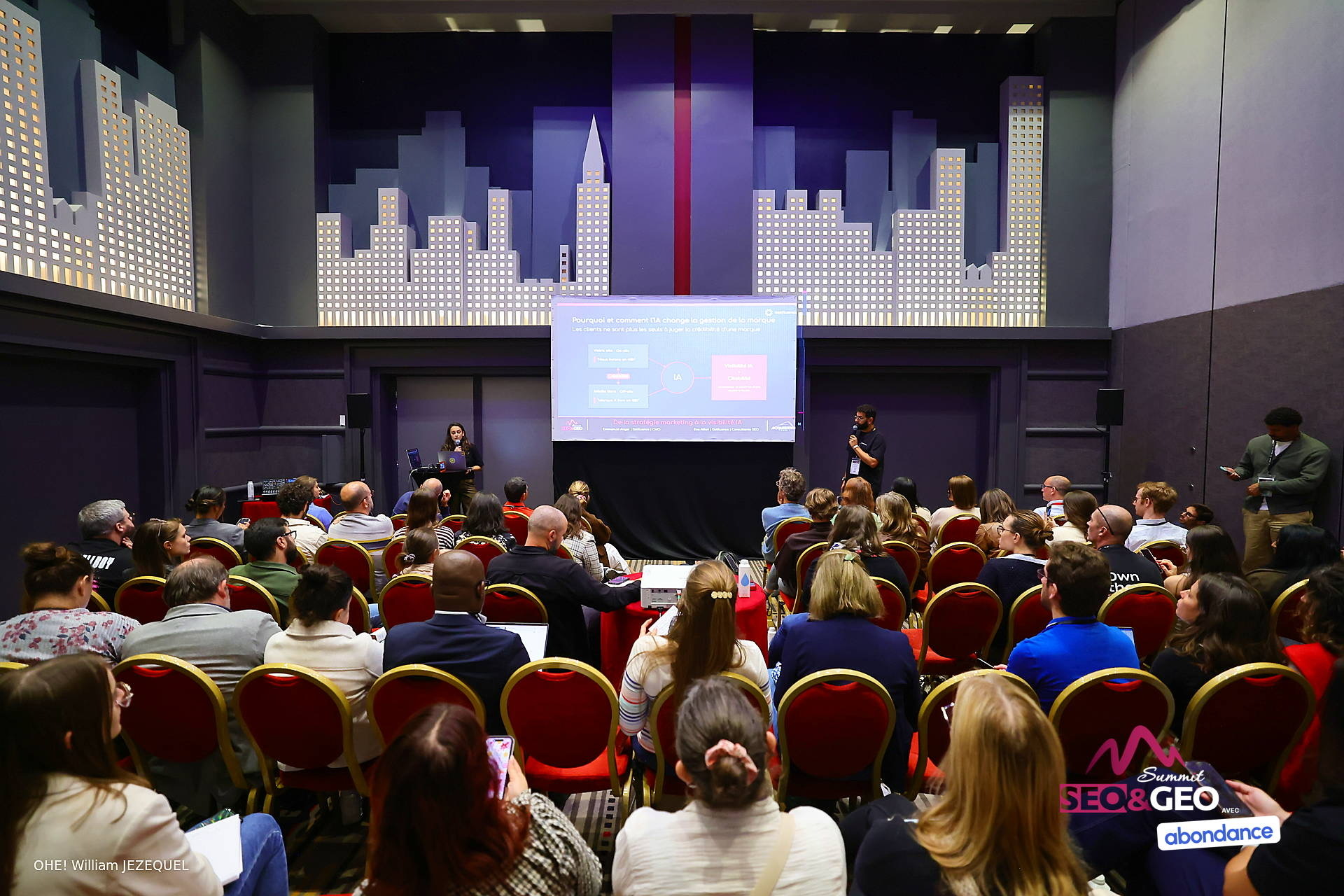
On October 16, 2026, Emmanuel Anger (CMO at Getfluence) and Eva Alfieri (SEO consultant at Getfluence) gave a talk titled "From Marketing Strategy to AI Visibility: How to Make Your Brand Message Survive All the Way to the AI Answer" at the SEO & GEO Summit, held at Disney’s Hotel New York (The Art of Marvel) convention center.
The starting point is simple. Brands want AI to talk about them, but they rarely check what AI actually says. A brand can be highly visible in ChatGPT or Gemini and still be described in a way it doesn't recognize. This article covers the findings, data, and method shared during the talk. Most of the studies cited are based on US data, so the takeaways apply directly to US brands.
Getfluence also presented a second talk at the event: "Why Choose Between SEO and GEO? 5 Tested Tips and Methods to Earn Rankings and AI Visibility," delivered by Christian Désert, CEO of Getfluence, and Olivier de Segonzac, Founding Partner at Resoneo.
Key takeaways
- 45% of marketing leaders can't accurately measure their brand's visibility in AI answers (Semrush, 2026).
- When AI rephrases a brand, it keeps the proof (numbers, dated facts, reviews) and drops the tone, signature, and storytelling.
- 85% of brand mentions in AI answers come from third-party sites (AirOps, 2026). Your website alone isn't enough.
- The method presented boils down to 4 steps: audit, rewrite, distribute, measure.
Marketing teams don't know what AI is saying about their brand
According to Semrush's 2026 AI Visibility Index, which analyzed 126 million US AI search prompts, 45% of marketing leaders can't accurately measure their brand's visibility in AI-generated answers, and only 9% have the tools to track every relevant metric across platforms.
In other words, many marketing teams have no idea what AI engines tell their prospects at the exact moment those prospects are researching their category. This goes beyond SEO and performance marketing. It directly affects brand and communications teams, which are often disconnected from search.
That's where brand drift comes in: the gradual erosion of a brand's message, one rephrasing after another. The facts stay accurate, but the tone, nuance, and framing fade with every summary. Semrush's report makes minimizing this drift across every touchpoint the starting point of any AI visibility strategy.
Getfluence has seen this firsthand. Older content described the platform as "premium," a positioning Getfluence doesn't claim. AI engines still repeat that label today. The only fix is to publish new, consistent content that says something different, and to repeat it.
Bottom line: a brand can be visible in AI and still be described the wrong way. AI visibility is as much a brand issue as a search issue.
What AI keeps from your brand, and what it loses
Trust in a brand rests on three dimensions: perceived value, identity, and community. AI engines do convey all three, but only through verifiable elements:
- perceived value, through numbers (benefits, measured results);
- identity, through dated facts (history, roots);
- community, through named and dated reviews and testimonials.
What gets lost along the way is tone, signature, and storytelling. What survives is proof. Storytelling isn't dead, but it no longer has a monopoly on persuasion.
At Getfluence, this principle shaped the brand platform redesign. Key messages were built alongside the platform itself, with sales, product, and marketing teams at the table. They rely on numbers that are repeated word for word on the website, in articles published on third-party media, and in sales decks: 70,000+ vetted media outlets across 150+ markets, a 92% order delivery rate, an average delivery time of 8 days, 30 days of post-publication monitoring, and a 12-month publication guarantee.
Repeating the exact same fact across multiple sources is what allows AI to absorb it and reuse it. A number that changes from one channel to another creates doubt, for AI and for readers alike. It's basic marketing, applied to AI: a customer who sees the same number on your site, in an article, and in your sales rep's pitch trusts you. AI works the same way.
Bottom line: a verifiable number survives rephrasing; a slogan doesn't. Your brand platform needs proof, not just a promise.
SEO and GEO: why they belong in the same workflow
As part of its study, Semrush surveyed 481 marketers. Among organizations that run SEO and AI visibility in a single, integrated workflow, 81% reported more traffic or leads from AI platforms. Among those managing the two separately, that figure drops to 36%.
The logic is straightforward. AI engines rely heavily on the existing web to build their answers, so solid SEO work already covers part of the GEO work. On the flip side, two teams working in parallel end up producing two different narratives. AI engines receive mixed signals, and the brand loses consistency, and with it, credibility.
For a CMO or head of communications, the real question isn't "Do we need a GEO team?" but "Who owns the brand narrative across all of search?" To dig deeper, see our page on GEO (Generative Engine Optimization).
Bottom line: splitting SEO and GEO risks creating two brand narratives. Teams that integrate them see results more often.
How AI reads (and slices up) your content
AI doesn't display a page. It extracts a sentence or a paragraph that directly answers the question. Two levels are worth distinguishing:
- a mention: the brand is named in the answer;
- a citation: the site is used as a source, with a link.
The result: content that makes sense out of context gets favored. Compare these two sentences:
- "With it, you'll never have to get up to clean again: it handles everything, even under the couch."
- "Brand Z's R7 robot vacuum cleans up to 1,600 sq ft per charge and fits under furniture as low as 3 inches."
Pulled out on its own, the first sentence doesn't say what the product is or who makes it. The second one stands on its own: product, brand, and two verifiable specs.
Consistency across sources matters just as much. If your website promises 2-day shipping and third-party sites say 2 to 5 business days, you lose the trust of both your customers and AI engines. Both now get a say in your credibility.
One last habit to rethink: mentioning your competitors. In digital PR, brands used to avoid naming them. AI engines, however, favor content that compares multiple options. An article that only talks about you reads like an ad. A comparison where you appear alongside your competitors, with objective criteria, becomes a source.
Bottom line: every paragraph should name the brand, say what it does, and give the proof. And if you want AI to talk about you, be willing to talk about others.
Fragile messages vs. solid messages
Not every message survives rephrasing the same way.
Both need to stay consistent. Storytelling that contradicts the facts gets exposed fast, because consumers (and AI engines) can check what a brand claims. A brand that markets itself as "Made in USA" when only a few components are actually made in the US is one AI answer away from being called out.
Customer reviews are among the most widely used forms of proof. According to a Seer Interactive study commissioned by Trustpilot, conducted in March 2026 across more than 800,000 AI responses for US brands, brands with no active Trustpilot profile were cited in just 1% of answers, compared with 75% for brands with an active profile (median of 81 reviews).
For Getfluence, that number was a wake-up call. Reviews had always been "important, but there's always something more important." After a period of negative buzz, the team reworked its messaging, spoke publicly with results-backed proof, and made review collection a priority. Getfluence's Trustpilot rating went from 3.6/5 to 4.5/5 in 7 months (51 reviews as of October 2026).
Bottom line: proof is the key to credibility. Reviews work for two audiences at once: your customers and AI engines.
Third-party media: the only lever that's both highly cited and controllable
The more control a brand has over a piece of content, the less AI engines trust it. According to AirOps' 2026 State of AI Search report, 85% of brand mentions in AI answers come from external domains. On category-level prompts, Profound found that brand-owned content accounts for only 4.3% of citations.
Third-party sources don't all offer the same level of control:
- owned content gives you full control but carries little weight in citations;
- communities and user-generated content (forums, reviews) get cited a lot but are hard to steer;
- third-party media get cited and stay controllable: you pick the outlet, commission the article, shape the message, and update it when the data changes.
You still need to target the right questions. Showing up on questions your audience never asks is pointless. The method presented starts from the keywords your site already ranks for and your existing buyer personas, then works out the questions those personas ask AI: their pain points and buying criteria. Since prompt volume can't be measured reliably yet, the goal isn't to chase the single most-asked question but to cover a topic from several angles.
That's the idea behind Getfluence's AI-First format: articles designed to be picked up by AI engines and published on the media outlets they already cite. Across 1,000+ articles published for 100+ brands in 20 industries, more than 60% of brands starting from zero earned an AI mention, with a median time of 20 days. Our guide to improving visibility in AI answers covers the available strategies and tools.
Bottom line: don't just publish where you want to be read. Publish where AI reads, on the questions your audience actually asks.
The 4-step method to stay in control of what AI says about you
- Audit. Who do you want to reach, and what value do you really deliver? Start by asking AI engines what they say about your brand, then compare their answers with your brand platform.
- Rewrite. Run your key messages through one filter: what can you prove? A message without a number, a dated fact, or proof will be ignored or distorted. Keep 3 to 5 solid messages and decide what you want AI to say about you.
- Distribute. Your website isn't enough. Publish your messages where AI goes looking for answers: the third-party media it already cites on your topic.
- Measure. What does AI say about you this month, and which questions do you show up for? This is ongoing tracking, not a one-off audit: AI visibility can grow fast, and fade just as fast.
To run that first diagnosis, attendees could download the Drift Check. The express version is a prompt to paste into ChatGPT, Claude, or Gemini for a first brand drift diagnosis in 5 minutes. The full version, a Markdown file to drop into your LLM, rewrites your brand platform into citable messages and prioritizes the GEO prompts to work on.
Bottom line: AI visibility isn't a technical task to hand off to the SEO team. It's a brand issue, owned by marketing and communications, working hand in hand with SEO.
AI will tell your brand's story, with or without you. What makes the difference is how solid the messages you feed it are: proof rather than promises, repeated consistently, and published where AI looks for answers. The first step takes 5 minutes: ask an AI what it thinks of your brand, and compare its answer with your brand platform.
Your questions about AI visibility and brand messaging
What is brand drift?
Brand drift is the gradual erosion of a brand's message as it gets rephrased over and over. In AI search, every summary strips away a bit of the tone, nuance, and framing the brand intended, even when the facts stay accurate. The risk is that AI engines associate the brand with a positioning it never chose.
How can I find out what AI says about my brand?
Start by asking AI engines (ChatGPT, Gemini, Claude, Perplexity) the same questions your customers ask: what your brand does, how it compares to competitors, what reviews say, how much it costs. Then compare the answers with your brand platform to spot the gaps.
Why do AI engines cite third-party sites more than a brand's own website?
Information confirmed by an independent source carries more weight than a claim published by the brand itself. According to AirOps, 85% of brand mentions in AI answers come from external domains. On category-level prompts, Profound found that brand-owned content accounts for only 4.3% of citations.
Should SEO and GEO be handled by separate teams?
The data points the other way. According to Semrush's 2026 AI Visibility Index, 81% of organizations that run SEO and AI visibility in a single workflow report more traffic or leads from AI platforms, versus 36% of those that manage them separately. Working in silos also tends to produce two brand narratives, which sends AI engines mixed signals.
Sources
- 2026 AI Visibility Index, Semrush, 2026 (45% and 9% of marketing leaders; 81% vs. 36%; 481 marketers surveyed).
- Study of 800K AI Responses: How Review Profiles Shape Brand Presence in AI Search, Seer Interactive for Trustpilot, 2026 (1% vs. 75%).
- 2026 AI Search Report (State of AI Search), AirOps, 2026 (85% of brand mentions).
- Who Shapes AI Answers? Introducing Enhanced Citation Categories, Profound, January 2026 (4.3% for brand-owned content).
- AI-First campaigns and Trustpilot rating: Getfluence internal data, 2026.