
ChatGPT for SEO: a practical guide with tips
ChatGPT is now both an SEO assistant and a search tool that cites its sources. Here are practical ways to use it for SEO, and the gaps you still need to fill.

Summary
ChatGPT and SEO: what has changed since 2023
When ChatGPT appeared, it was mostly a writing assistant. Today it has become part of how people search.
Since October 2024, ChatGPT search can look up current information on the web and answer with links to its sources, such as news articles and blog posts. OpenAI opened it to everyone in regions where ChatGPT is available in February 2025.
This matters for SEO in two ways.
First, ChatGPT is a practical tool for SEO work: research, planning, writing support, structured data, data analysis. Second, it is a place where your brand can be recommended, or not, when users ask questions about your market. At its DevDay 2026, OpenAI spoke of "our collective 1.2B weekly users" across its products.
Google remains the main search engine, with 89.94% of the worldwide market in September 2026 according to Statcounter. So the question is not "Google or ChatGPT" but how to use ChatGPT to do better SEO, and how to be visible in both.
So how can businesses use ChatGPT for SEO?
Let's look at the most useful ways to use ChatGPT for your SEO game, what it can really do, and where human expertise and other tools are still needed.
5 best tips to use ChatGPT for SEO
There are many ways you can use ChatGPT to improve your SEO efforts.
Here are 5 best practices to do it:
1. Use ChatGPT for keyword research and analysis
ChatGPT can help you with keyword research by generating lists of related keywords, questions and variations around a topic.
This is especially useful to discover terms and angles you may not have considered yet, including the long, conversational questions people now type into AI assistants.
To do this, describe your business, your audience and the topic, and ask for keywords grouped by search intent (informational, comparison, transactional).
ChatGPT does not have reliable search volume or difficulty data on its own, so treat its list as a starting point.
Then check each keyword in your usual SEO tool and Google Search Console to see real volumes, competition and the pages already ranking.
Combining ChatGPT with your 'traditional' keyword research tools helps you cover your audience's questions more completely and saves time on the brainstorming phase.
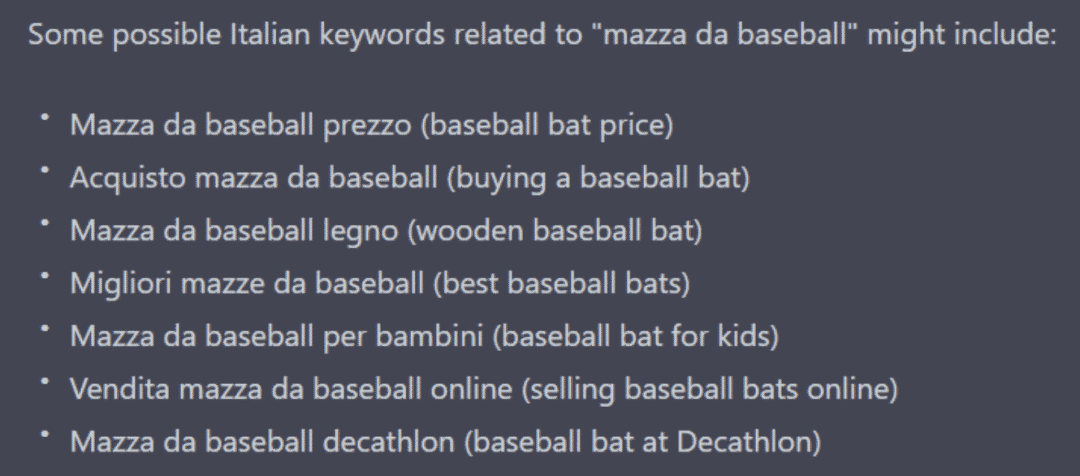
Also, here's a bonus tip: if you're targeting a foreign language you don't speak, ChatGPT can suggest local keyword variations. Have a native speaker or local data validate them, since literal translations often miss how people really search.
Here's an example:
2. Use ChatGPT to develop your content strategy
ChatGPT can help businesses outline their content marketing strategy.
Give it a topic and your target audience, and it will suggest subtopics, article ideas and a possible structure for a topic cluster.
Combined with solid market research, this helps you focus your content on what your audience is actually looking for, which improves your chances of ranking and of being cited in AI answers.
And it doesn't end here.
You can also paste your list of existing articles and ask ChatGPT to identify gaps in your content, such as questions in your niche that you have not answered yet.
Ultimately, this helps you build a more complete approach to SEO and 'be there' for your audience when a question related to your expertise is asked, on Google or in an AI assistant.
3. ChatGPT to optimize images' and videos' alt text
Writing alt text for every image and video can be time-consuming, and ChatGPT can speed up the process.
You can use ChatGPT to draft descriptive alt text for your media, which search engines use to understand what an image shows.
Relevant, descriptive alt text makes your website more accessible to people with impaired vision, and it also helps your SEO.
Optimized alt text can help you:
- Rank better in image search;
- Appear in the image pack on results pages;
- Give search engines' crawlers more context on what your content is about.
To do it, provide the image (or a short description of it) to ChatGPT, along with the page topic and the keyword you are working on, and ask for a short, factual alt text.
Check that the result describes what is really in the image and does not simply stuff keywords.
Here's an example of how to do it:
Input: "This is an image of a black and white cat sitting on a windowsill, looking out the window. Please write an alt text that conveys this."
Output: "Black and white cat sitting on a windowsill, looking out the window."
Accurate, descriptive alt text improves the visibility of your media in image and video search results.
This can bring additional traffic to your website and improve your overall online visibility.
4. Optimize meta tags and structured data with ChatGPT
You can use ChatGPT to write and improve your meta tags, which tell search engines and users what your page is about.
First, as we have seen, ChatGPT can help you choose the main keyword and related terms to include in your title tag.
Second, you can ask it for several title and meta description options within a given length (for example, under 60 and 155 characters), then pick and adjust the best one.
Third, ChatGPT can draft structured data in JSON-LD (FAQ, article, product, organization) from your page content. Always test the result with Google's Rich Results Test before publishing.
Used this way, ChatGPT helps make sure your pages are accurately described in the search results and easy for search engines to understand.
5. ChatGPT for SEO content creation

Businesses can use ChatGPT to support SEO content creation: topic ideas, outlines, first drafts of sections, FAQs, rewrites for clarity.
However, ChatGPT works from what it has learned and what it finds online. It cannot bring your own data, customer stories or field experience unless you give them to it.
It can also make mistakes or state wrong facts with confidence, which is why every figure and claim must be checked against a reliable source before publishing.
Finally, unedited AI text tends to repeat the same expressions and can sound generic or verbose.
Google's position is that it rewards helpful content, whatever the way it is produced, but content created mainly to manipulate rankings goes against its spam policies. So use ChatGPT as a tool that supports your writers, not as a replacement for them.
In practice, let ChatGPT speed up research and drafting, then add your own perspective, examples, data and voice. This is what gives a page information that others do not have, and a reason to be cited.
By combining ChatGPT with your own expertise and critical thinking, you can create high-quality content that attracts your audience and supports your SEO goals.
What ChatGPT can not do for SEO
ChatGPT is a powerful assistant, but there are parts of SEO it cannot do for you.
It can now help with technical SEO: explaining a crawl report, writing a robots.txt rule, a redirect map or a regular expression, analysing an export from your tools. But it cannot replace a crawler, your server logs or Google Search Console data, and every technical change must be tested.
Most importantly, ChatGPT can't:
- Earn off-page signals for you: it cannot get your brand published, cited or linked by other websites (backlinks, media coverage, mentions on trusted sites);
- Guarantee that your brand will be recommended in its own answers, which draw on what trusted third-party sources say about you.
In addition, there's one key factor ChatGPT cannot build for you: brand identity.
Just think of it.
Ranking high in the search results helps your image, but it does not mean the public will suddenly feel attracted to your brand or trust it.
Brand identity is what turns website visitors into customers, and customers into loyal, returning clients.
Ultimately, we suggest you take advantage of ChatGPT for your SEO work, while keeping the human expertise and other tools your strategy needs.
How to fill in ChatGPT's SEO gaps to build a solid SEO strategy
As we have seen, ChatGPT can improve your SEO work, but it is not enough to build an SEO strategy that lasts.
Sure, ChatGPT can help you make certain aspects of your SEO game run better…
But what does it matter if your approach misses the factors that build authority over time?
Relying too much on AI-generated content can waste time and resources, and hurt your brand's reputation if errors get published.
To avoid that, aim for an approach that covers all the pillars of SEO: content, technical health and authority. Authority comes from links and mentions on credible sites, and it is also what AI assistants look at when they choose which brands and sources to cite.
You can work on it with Getfluence.
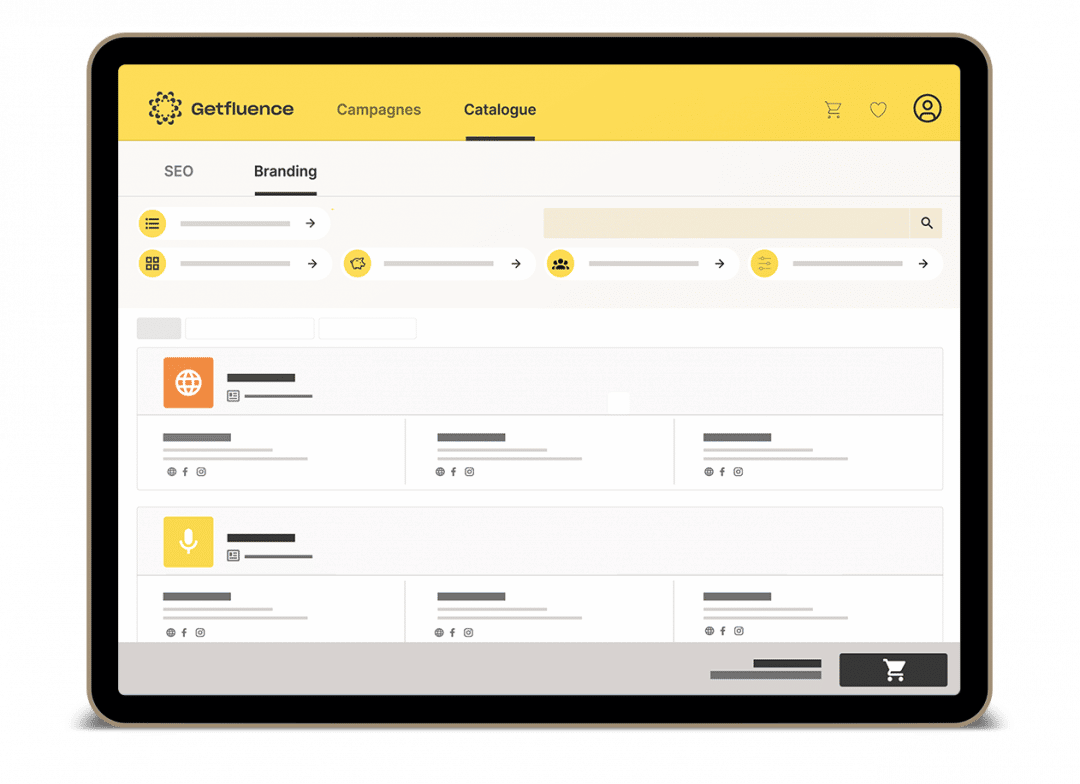
Getfluence is a sponsored content marketplace and agency that works with more than 70,000 vetted media around the world. More than 5,000 brands and agencies use it to build an effective and stable SEO strategy.
With Getfluence, you can fill ChatGPT's main SEO gaps in two ways:
- By publishing content about your brand on reliable, relevant publishers, you earn contextual backlinks that help your website rank higher in the search results;
- By being mentioned on trusted websites in your area of expertise, you reach your target audience, build trust in your brand, and appear in the kind of sources that AI answers draw on.
Links and brand mentions work together: one supports your rankings, the other your reputation, and both feed your visibility in AI search.
Getfluence's simple interface and pre-negotiated prices with publishers help you save time and budget on your campaigns.
Build your SEO strategy with ChatGPT and Getfluence now.
Most asked questions about ChatGPT for SEO
Is ChatGPT good for SEO?
ChatGPT is a useful assistant for SEO: keyword ideas, content planning, meta tags, structured data and analysis of exports. It is not enough on its own to build a solid SEO strategy. You get the most out of it by combining it with human expertise, real search data and other SEO tools.
How do I use ChatGPT for content?
You can use ChatGPT to support content creation in many ways, from keyword research and topic ideas to outlines and first drafts. Always check the facts it gives, and add your own data, examples and voice so the content reflects your brand and is genuinely useful to your audience.
Can companies use ChatGPT?
Companies use ChatGPT in many ways, from making internal processes smoother to improving their SEO with better keyword research, optimized alt text and meta tags, and faster content production. For sensitive data, check the plan and settings your company uses before sharing information.
Can my website appear in ChatGPT answers?
Yes. ChatGPT search answers with links to its sources. To increase your chances of being cited, publish clear, well-structured and useful content, and build your presence on trusted third-party sites, such as media and specialist publications, that link to you and mention your brand.