
SEO best practices to help your articles rank on Google
Google ranking factors keep changing, and AI Overviews now take part of the clicks. Here are five SEO practices that still help articles rank and get cited.

Summary
The SEO practices that still make a difference
Google ranking factors keep changing.
Search moves fast, and it can be hard for SEO professionals to keep up with Google’s requirements while aiming for the top spots.
To give an idea of the pace, Google says it made 4,781 launches to Search in 2023, after 16,871 live traffic experiments and 719,326 search quality tests (Google, How Search Works).
Most of these changes go unnoticed, but some of them change how Google decides which page to show first, so it pays to know which practices hold up over time.
Search is still the main way people find content. Google handled 89.94% of worldwide search engine traffic in September 2026 (Statcounter), and B2B marketers rank website, blog and SEO first both for usage (48.4%) and for ROI (30.2%) according to HubSpot.
What has changed is the results page itself. Google’s AI Overviews now reach more than 2.5 billion monthly users and AI Mode has passed 1 billion (Google I/O 2026). Both arrived in France in July 2026.
These AI answers take clicks. In a Pew Research Center study, users clicked a traditional result on 8% of visits when an AI summary appeared, against 15% without one. Ahrefs measured a 58% lower average click-through rate for the first position when an AI Overview is shown.
What does this mean?
Ranking well is still necessary, but it is no longer enough. Your page also needs to be the kind of source that Google and AI assistants choose to quote, and your brand needs to be mentioned on websites they trust.
At Getfluence, we have kept the five practices that work best for the articles we follow, and updated them to match how Google works today.
Here they are:
1. ‘People also ask’
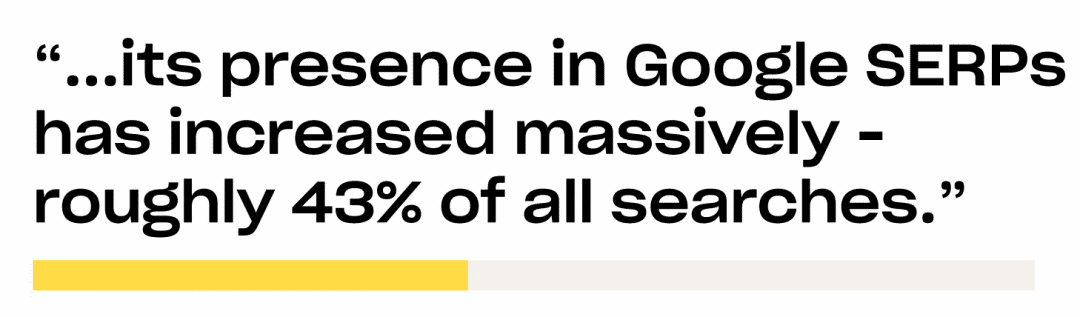
The “People also ask” (PAA) box shows related questions with short answers taken from web pages. It is one of the most common features on Google’s results pages.
Getting your page featured as an answer puts it in front of readers who are already looking for that information, often above some of the classic blue links.
But why is PAA so important?
First, it shows up very often: Semrush Sensor found a PAA box in 51.85% of searches in August 2024 (Semrush).
Second, most of your readers search on a phone. Mobile accounted for 58.99% of worldwide web traffic in September 2026, against 39.26% for desktop (Statcounter), so check how your results look on a small screen.
So, how can you help your website get featured in the PAA box?
The first step is to list the questions people ask most around your chosen keywords.
Skip questions nobody searches for, and keep those that match your audience’s intent.
Look at what your readers want to know, then write content that answers their doubts fully, starting with a short, direct answer in the first sentence.
Finally, use questions directly in your headings (H2s, H3s, H4s) or add an FAQ section. This format also helps AI Overviews and chat assistants, which pick up short, clearly stated answers.
2. Implement schema markup
Behind the scenes, schema markup (structured data) helps Google and other search engines understand what your page is about: an article, a product, a recipe, an event, an author.
Proper structured data makes your pages eligible for rich results, which can make your listing more visible and more attractive to readers.
Keep your expectations realistic, though. Markup makes a page eligible, it does not guarantee a rich result, and Google has reduced some formats over time: since 2023, FAQ rich results are mostly shown for well-known government and health websites.
Search is also less and less about typing. Google’s AI Mode accepts text, voice or image queries (Google France), so voice is now one way among others to ask a question rather than a separate channel.
Clean, accurate markup that matches the visible content helps machines read your page correctly, whatever the query format.
Simplify your SEO strategy with Google’s Structured Data Markup Helper
To help you add structured data, Google offers a free tool, Google’s Structured Data Markup Helper.
It takes care of the most technical part of the job and lets you tag the elements of a page without writing all the code by hand.
Once your markup is live, test it with Google’s Rich Results Test and follow any errors reported in Search Console.
3. Google Discover
Like the feeds of social networks, Google Discover suggests content to users based on their interests, without them typing a query.
For news sites, blogs and media, Discover can bring a significant share of traffic, so it deserves a place in your SEO routine.
There is no specific markup or setting to apply for. Google’s Discover guidelines point to four things you can work on:
- Speed and page experience
A fast, stable page on mobile matters, especially if your website is not yet well known. - Relevance
Content is shown according to each user’s interests and activity.
Websites that cover a subject in depth are more likely to be shown to people interested in that topic. - Honest, click-worthy titles
Titles should make people want to read, but Google explicitly advises against clickbait and misleading titles, which can hurt your visibility. - Large, high-quality images
Lastly, use a large, relevant image for each article: Discover is a visual feed and images weigh heavily on clicks.
4. Core Web Vitals
Core Web Vitals are Google’s measures of real user experience on a page. They are part of the signals its ranking systems use, and they apply to every page, whatever the technology behind it.
The list changed in March 2024, when Interaction to Next Paint (INP) officially replaced First Input Delay (FID) (web.dev).
Core Web Vitals now consist of three elements, with the following “good” thresholds:
- Largest Contentful Paint (LCP), which measures how quickly users see the main content: 2.5 seconds or less;
- Interaction to Next Paint (INP), which measures how quickly the page responds to clicks, taps and key presses: under 200 milliseconds;
- Cumulative Layout Shift (CLS), which measures how much elements move around while the user reads or interacts: under 0.1.
These thresholds come from Google Search Central. You can follow your scores in the Core Web Vitals report of Search Console and in PageSpeed Insights.
Keep them in proportion: good scores will not make a weak page rank, and Google still puts relevance and quality first. But when several pages answer a query equally well, a smooth experience can make the difference, and it helps keep visitors on your site.
Accelerated mobile pages and Core Web Vitals
With Accelerated mobile pages (AMP), Google wanted to offer mobile users fast-loading pages.
For a long time, AMP was needed to appear in the Top Stories carousel on mobile. That is no longer the case: since the page experience update rolled out in June 2021, Top Stories is open to any page that follows Google News content policies.
AMP is now optional and is not a ranking requirement. If your AMP pages work well and are maintained, you can keep them; if you are starting from scratch, focus on making your standard pages fast and meeting the Core Web Vitals thresholds.
5. Follow E-E-A-T guidelines
“E-E-A-T” stands for “Experience, Expertise, Authoritativeness and Trustworthiness”.
The concept comes from Google’s Search Quality Rater Guidelines, the document used by the people who evaluate the quality of search results. Google added the first “E”, for Experience, in December 2022 (Google Search Central).
The guidelines are updated regularly. The January 2025 version added pages on spam, AI-generated content and low-effort content, and the September 2025 version added examples of AI Overviews and widened the “Your Money or Your Life” topics (official guidelines).
Raters do not change rankings directly, but their guidelines describe what Google’s systems try to reward, so they are a good checklist for your content.
Several E-E-A-T elements relate to the person or brand behind the content.
This makes it important for authors to build a good reputation in their field, on your site and elsewhere on the web.
Good practices include author pages and “about us” pages, first-hand experience in your articles (tests, examples, your own data), and mentions of the author or brand in reliable, recognized media.
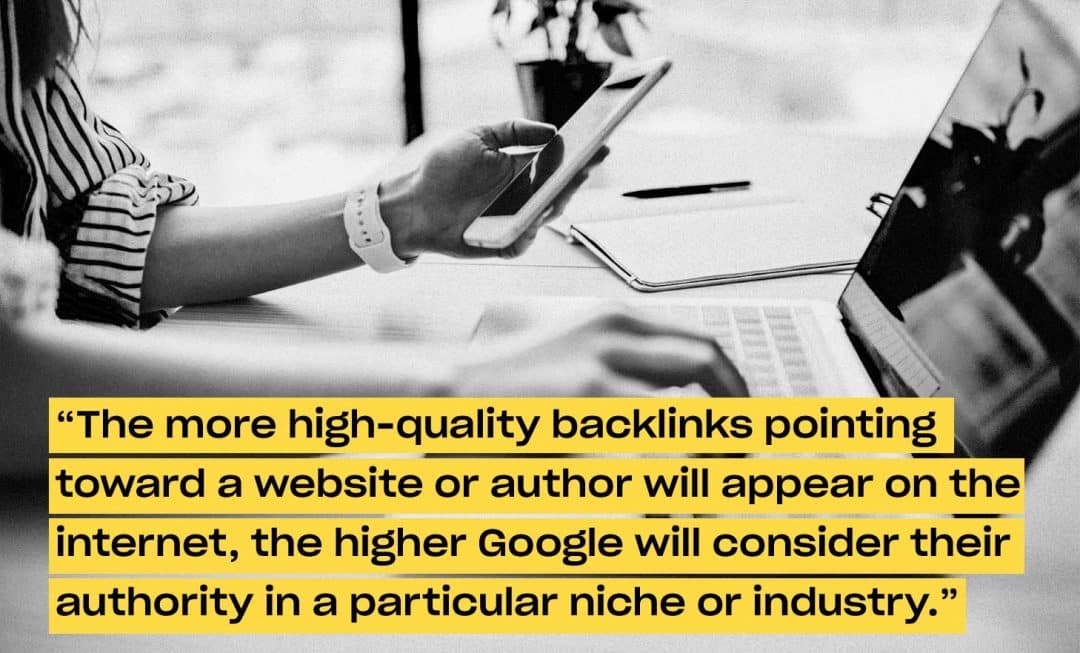
High-quality backlinks from relevant websites remain one of the clearest signals of authority in a niche or industry.
Mentions in third-party media also count for readers. In the Edelman Trust Barometer 2026 report on brands, 41% of people say that what unpaid people say about a brand has the biggest effect on their trust, against 20% for what the brand says about itself. AI assistants work in a similar way: when they answer a question, they cite the sources they consider reliable, often established media.
Along with that, refresh your content regularly and link to reliable sources for your stats and data.
Develop your online reputation with Getfluence
To meet E-E-A-T expectations, your brand needs to be present on respected websites in your field, and not only on your own.
For instance, you can plan sponsored articles and other publications on trustworthy media that cover your topic.
The right tools help you do this without wasting budget on websites that bring neither readers nor authority.
This is where Getfluence can help.
With more than 70,000 vetted media around the world, already used by 5,000+ brands and agencies, Getfluence helps you run campaigns with trustworthy websites in your area of expertise, with contextual backlinks pointing to your content.
All media are selected on trusted SEO KPIs such as domain authority, trust flow and citation flow, so you work with relevant and reliable websites for your link building.
Links and brand mentions work together: a link in a well-written, contextual article helps your rankings, and the same article on a media outlet that AI engines cite helps your brand appear in their answers. That is the aim of our AI-First™ offer.
Why does this matter?
Because it gives you more time to focus on the rest of your project, while working with media and professionals you can trust.
Try out Getfluence features and take advantage of its competitive prices right now.
Most asked questions about SEO best practices
Which SEO practices matter most for articles today?
Answer the questions your readers really ask, with a clear answer at the top of each section. Add accurate structured data, keep your pages fast on mobile, show who writes your content and why they can be trusted, and earn links and mentions from relevant media.
Do Core Web Vitals and AMP still matter for SEO?
Core Web Vitals do: since March 2024 they are LCP, INP (which replaced FID) and CLS, and Google uses them as part of its ranking systems. AMP is optional: since 2021 it is no longer required to appear in Top Stories, and any fast page that follows Google News policies can be shown there.
How do AI Overviews and AI Mode change SEO?
They answer part of the question directly on the results page, so fewer users click on classic results. SEO basics still apply, since AI answers rely on pages Google can crawl and trust. The goal now is also to be among the sources these answers cite, which is easier when your brand appears in recognized third-party media.