
Backlinks: do they still carry weight on Google and in AI answers?
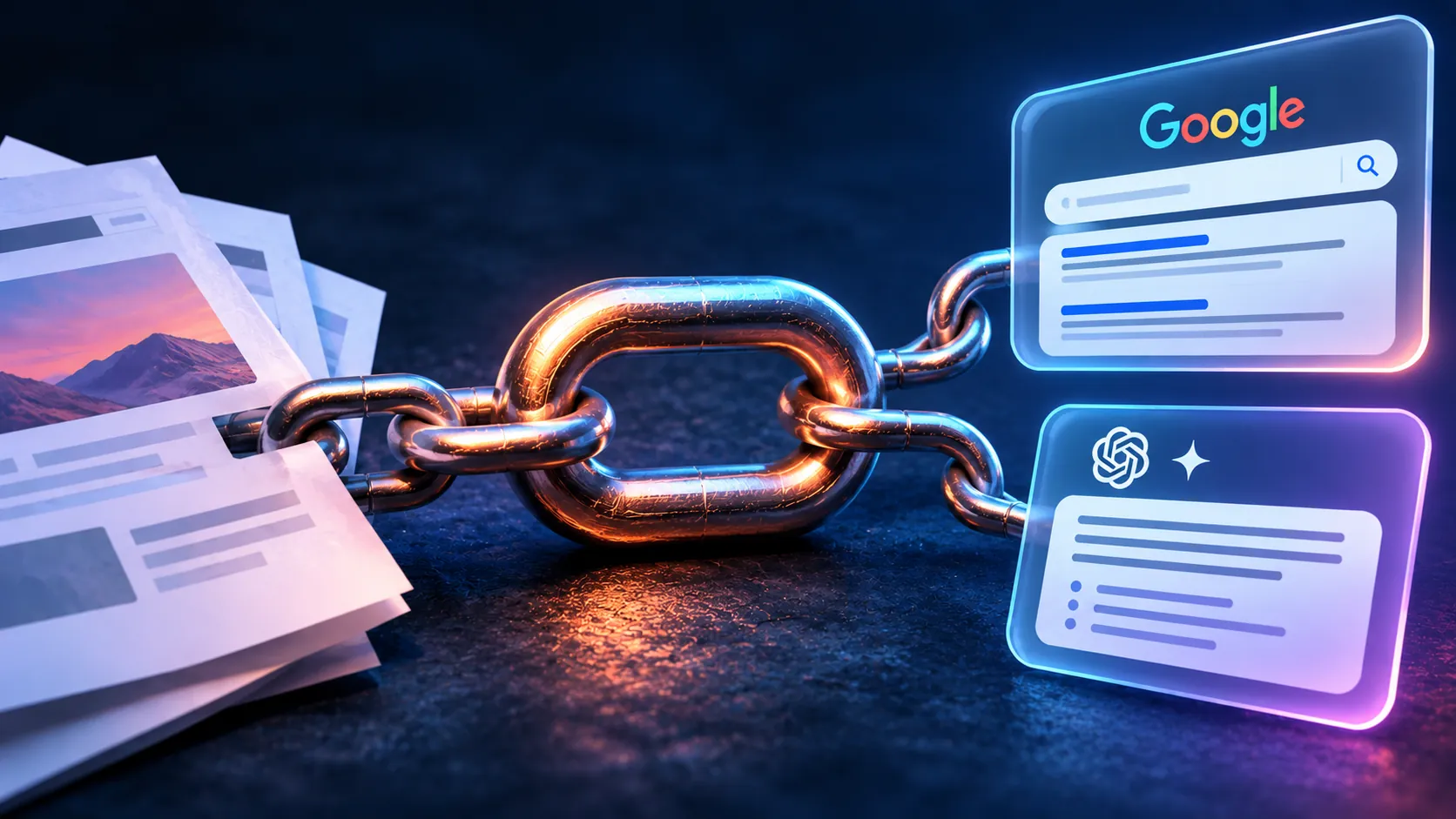
Yes, backlinks still matter: Google reads them as a trust signal and they help your pages get picked up by AI. Their context counts more than their volume.
Summary
Backlinks were the original fuel of Google rankings. In 2026, a growing share of searches ends in an AI-generated answer (AI Overviews, AI Mode, ChatGPT, Perplexity), and every marketing team asks the same question: does a link to your site still do anything?
Yes, but not for the same reasons as ten years ago. Volume matters less. The media outlet that carries the link and the content around it matter more, on Google and in AI answers alike. Here is the exact definition, the role of links on Google and in AI, quality criteria, methods, monitoring and the practices to avoid.
Key takeaways
- A backlink is a link from an external site to yours. Google reads it as a signal that other sites point to your content.
- On Google, the number of referring domains remains correlated with a page's organic traffic.
- In AI answers, links mostly work indirectly: they help your pages rank, and therefore get retrieved, and the media outlets that carry them are often cited as sources.
- A good backlink is judged on its context (topic, real traffic, useful content, natural anchor), not on a score alone.
Backlink: definition and how it works
A backlink (or inbound link) is a link placed on an external site that points to a page on your site. The clickable text is the anchor, and the site that links to you is the referring domain.
Google uses these links in two ways. Its crawlers follow them to discover new pages. Its ranking systems read them as a signal: on its page explaining how results are ranked, Google says it tries to understand whether other prominent websites link or refer to a piece of content, and that this is generally a good sign the information is trustworthy.
"Dofollow" is not an HTML attribute: it is the default link, with no attribute. The attributes that do exist are nofollow (link not endorsed), ugc (user-generated content) and sponsored (advertising links). Since September 2019, Google treats them as hints rather than strict directives.
Takeaway: a backlink is a link from another site to yours. Google uses it to discover your pages and to estimate how much other sites trust them.
Why backlinks matter for Google rankings
In its December 2023 study of about 14 billion pages, Ahrefs found that 96.55% of pages get no traffic from Google, and noted a clear correlation between the number of sites linking to a page and its traffic. A correlation, not proof: pages that attract links are also often the most useful ones.
In practice, links serve three SEO goals:
- Speed up discovery of a new or deep page.
- Strengthen a page on a competitive query, when the content is on par but competitors receive more links from sites on the topic.
- Build a domain's authority on a subject, which benefits all its pages through internal linking.
That is the principle of a link building strategy based on media outlets in your field: fewer links, placed in content that readers and Google take seriously.
Takeaway: Google still presents links as a trust signal. A link alone does not make a ranking: it amplifies content that is already useful.
The role of backlinks in AI answers
For AI Overviews and AI Mode, Google is explicit. Its documentation on AI features and your website states that SEO best practices still apply, with no special optimization required. The signals that rank a page, links included, therefore come into play upstream of these answers.
A citation is a page displayed as a source of the answer. A mention is the brand name written in the answer. A page can also be read without being cited.
On citations, the study by Chen, Wang, Chen and Koudas (University of Toronto, September 2025) shows that AI search engines mostly cite third-party media ("earned media"). For automotive queries in the United States, 81.9% of the sources cited by GPT with web search are third-party media, compared with 45.1% of Google results. This is the finding behind our article on why third-party media weigh more in AI citations.
In the campaigns Getfluence analyzes for its clients, a media outlet is chosen first on its topic and on its presence among the sources AI cites for the target queries, before its authority scores. The same sponsored article can thus provide a link that helps SEO and a presence in a source that assistants pick up.
On mentions, recent studies qualify the role of link volume. Ahrefs (75,000 brands, December 2025, updated in August 2026) finds a strong correlation between brand mentions on the web and mentions in AI answers (0.709 for AI Mode), a weaker correlation for Domain Rating (from 0.266 to 0.326 depending on the platform) and a very weak correlation for the raw number of backlinks. Semrush (1,000 domains, October 2025) observes a threshold effect: link authority is associated with more AI mentions (0.65 Pearson), but mostly for domains that are already highly authoritative. It is not the volume of links that counts, it is their context: an article in a media outlet on the topic brings both a link and a brand mention.
Takeaway: links help your pages rank, and therefore get retrieved by AI, and the media outlets that carry them are often the cited sources. Raw link volume explains little of brand mentions.
Recognizing a quality backlink: 7 criteria
Tool scores (Domain Rating at Ahrefs, Authority Score at Semrush, Trust Flow at Majestic) help sort a list of sites. They do not tell you whether a link is useful for your page. This table lists the criteria to check on the page itself.
| Criterion | What to check | Warning sign |
|---|---|---|
| Topic | The site and the section cover your industry | General site publishing on every subject with no editorial line |
| Real organic traffic | The site gets visits from Google on queries related to its subject | High authority score but near-zero or falling traffic |
| Link context | The link sits in the body of content useful to the reader | Link in the footer, sidebar or a list of links |
| Anchor | Descriptive, natural text (brand name, title, useful phrase) | Exact-match keyword repeated across many links |
| Indexing | The page carrying the link is indexed by Google | Page missing from the index or blocked |
| Outbound links on the page | A few chosen links to consistent sources | Dozens of outbound links to unrelated sites |
| Presence in AI sources | The outlet appears among the sources cited for your queries | No presence on the prompts of your market |
The last criterion is checked by testing the prompts of your market (ChatGPT, Perplexity, AI Mode) and noting the cited domains.
Takeaway: a quality backlink is recognized by its context (topic, traffic, position in the text, anchor). Scores help sort, not decide.
How to earn lasting backlinks
Links that last come from content other sites have a reason to mention. Five methods cover most cases:
- Publish reference content: original data, studies, barometers, free tools or comprehensive guides. This is the content journalists and bloggers pick up.
- Work on press relations: offer media outlets in your industry an angle, a data point or an expert. An article earned this way brings a link and a brand mention.
- Publish contextual sponsored articles: useful content, published in an outlet on your topic, with a link and an anchor that fit naturally. Context and the absence of manipulation make the difference, not the fact that the content is paid.
- Recover lost or broken links: find links pointing to deleted pages and redirect them, or offer a replacement page to sites that cited a resource that no longer exists.
- Turn unlinked mentions into links: spot articles that name your brand without linking and contact the publisher.
These methods work together: an industry barometer feeds press relations, articles published in outlets on the topic and spontaneous links.
Takeaway: a lasting link relies on content other sites have a reason to mention, published in an outlet that covers your subject.
Monitoring and analyzing your backlink profile
The Search Console "Links" report is the free starting point: it shows a sample of the sites linking to you, your most linked pages and the most used anchors. Third-party tools (Ahrefs, Semrush, Majestic, SE Ranking) add history, new and lost links, and competitor comparison.
A monthly routine is enough for most sites:
- New and lost links: check that links earned in campaigns are still online and indexed.
- Referring domains: track their number and topic rather than the total number of links.
- Anchor distribution: spot an abnormal share of exact-match anchors.
- Target pages: check that links land on the pages meant to rank, then that internal linking passes them on.
- AI visibility: test your key prompts and note both the pages cited as sources and the mentions of your brand. Tracking tools measure one or the other depending on their method, and none sees pages read by AI without being cited.
Takeaway: track referring domains, lost links and anchors every month, and add a record of AI citations and mentions on your key prompts.
Risky practices: PBNs, excessive exchanges and automated links
Google's spam policies define link spam as creating links primarily to manipulate rankings. Examples include excessive link exchanges, automated programs or services that create links, footer links widely distributed across many sites, low-quality directories and low-value content created mainly to manipulate link signals.
PBNs (private blog networks) fall into this last category: sites created or bought to link to a target site, with no real audience. Their footprints are well known: thin content, unrelated topics, many outbound links, little organic traffic. Automated backlink generators produce the same kind of signals at scale.
The risk is twofold. Google can ignore these links or apply a manual action to the site. And these sites have almost no chance of being cited by AI, since they are neither read nor picked up by other sources. The alternative is the same as for any lasting link: a real media outlet, a consistent topic, content useful to the reader.
Takeaway: Google penalizes links created to manipulate rankings, not links as such. A PBN or massive link exchange brings risk with no benefit in AI answers.
Backlinks remain a trust signal for Google and an indirect lever for visibility in AI answers, as long as you judge them on their context rather than their volume. The right move is to start from the media outlets in your field that AI already cites on your queries, then publish content there that deserves a link. Test your key prompts this month: the list of cited domains is your first link building plan.
Your questions about backlinks and their weight in SEO
What is a backlink in SEO?
A backlink is a hyperlink on an external site that points to a page on your site. Google uses it to find new pages and to assess whether other recognized sites point to a piece of content. A backlink only has value if it sits in content related to your topic, on a real site that people read.
Are backlinks still useful in 2026?
Yes. Google still lists links among the signals that help it judge whether content is trustworthy, and it states that SEO best practices also apply to AI Overviews and AI Mode. What has changed is the weight of volume: recent studies show that a link counts mostly through the outlet that carries it and the context in which it appears.
How many backlinks do you need to rank well?
There is no reference number. The need depends on competition for the query: compare the number of referring domains of the pages in the top 10 with that of your page. A few links from outlets in your field are worth more than a large volume of links from sites unrelated to your subject.
How can you tell if a backlink is high quality?
Check that the site covers your topic, gets real organic traffic, places the link in useful content with a natural anchor, and that the page is indexed. Third-party authority scores help sort sites, but they do not replace reading the page.
Do backlinks help you appear in ChatGPT or Perplexity?
Indirectly. Pages that rank well in search engines are more likely to be retrieved by AI assistants, and the third-party outlets that carry your links are also sources these assistants often cite. Studies show, however, that link volume alone is weakly related to brand mentions in AI answers: editorial context matters more.
Sources
- How Search works: ranking results, Google, accessed November, 2026
- AI features and your website, Google Search Central, accessed November, 2026
- Spam policies for Google web search, Google Search Central, accessed November, 2026
- Evolving nofollow: new ways to identify the nature of links, Google Search Central Blog, 2019
- 96.55% of Content Gets No Traffic From Google, Ahrefs, 2023
- Top Brand Visibility Factors in ChatGPT, AI Mode, and AI Overviews (75k Brands Studied), Ahrefs, 2025 (updated August 2026)
- Do Backlinks Still Matter in AI Search? Insights from 1,000 Domains, Semrush, 2025
- Generative Engine Optimization: How to Dominate AI Search, Mahe Chen, Xiaoxuan Wang, Kaiwen Chen and Nick Koudas, arXiv 2509.08919, 2025